What happens if a removalist damages something during a Canterbury-Bankstown move?
Most people booking a move think about the price, the truck and the day. Far fewer ask the question that actually matters when something goes wrong: if a corner gets knocked off the buffet on the stairs, who pays for it? It is worth knowing the answer before move day, because the honest version is a little more involved than “they’re insured, it’s fine.”
Across Canterbury-Bankstown this is not an abstract worry. The area splits into two very different damage-risk pictures. In the unit-heavy north and centre, the risk lives on the stairs: most of the walk-up flats in Lakemba, Campsie and the older blocks off Bankstown’s Chapel Road have no lift, so a fridge, a lounge or a wardrobe comes down two or three flights by hand. In the house-dominant south, Greenacre, Revesby and Padstow, the risk is volume and value: a big multigenerational home holds a lot of furniture, including the pieces a family actually cares about. Both are exactly the moves where it pays to know how cover works.
Your first protection is the law, not a policy
Before any insurance, you have rights under the Australian Consumer Law. A removal is a service, and the ACCC is clear that services must be delivered with due care and skill. In plain terms, the removalist has to do the job to the standard a competent professional would. If they fall short and damage your goods through carelessness, you are entitled to a remedy, which can mean repair, replacement or compensation.
There is an honest catch, and it is the one that catches people out. The same ACCC guidance notes you cannot claim a remedy if the problem came from how you used the service rather than how it was delivered. For a move, the clearest example is a box you packed yourself that arrives with broken contents inside: if the crew handled the carton carefully but the wrapping inside was thin, that is not a failure of their care and skill. This is why owner-packed boxes sit in a different bucket from everything else, and we come back to it below.
Carrier liability is a floor, not a safety net
Here is the distinction that trips up almost everyone. When a removalist talks about being “liable” for your goods, they usually mean carrier liability, which is the limited baseline responsibility for items in their care. It is set deliberately low. On its own it is a floor, not full protection, and it will rarely come close to the replacement value of a houseful of furniture, let alone a genuinely valuable piece.
Transit insurance is a separate thing entirely. It is cover taken out for the move, protecting the goods themselves up to a value you declare, so a claim is about replacing your property rather than proving the removalist was at fault. AFRA members, for instance, can arrange goods-in-transit insurance through a preferred supplier alongside the public liability insurance every member carries. The mistake to avoid is assuming carrier liability and transit insurance are the same words for the same thing. They are not, and the gap between them is where uninsured losses happen.
The honest summary: the law gives you a remedy when the removalist is careless; carrier liability is a low baseline; transit insurance is the cover that actually matches the value of your things. Decide which you are relying on before the truck arrives, not after a box hits the stairs.
The owner-packed box trap
This is the single most useful thing to understand for a Canterbury-Bankstown move, and it bites hardest in the big southern homes where families pack themselves to save money. Cover for cartons you packed yourself is commonly limited or excluded for breakage, because the insurer has no way of knowing how the contents were wrapped. The crew can carry your box with perfect care and a poorly padded glass still breaks inside it.
So the choice is genuinely yours to make with open eyes:
- Pack it yourself to save on labour, and accept that the contents of those cartons are largely on you if something inside breaks. Fine for linen, books and the unbreakable bulk of a house.
- Have the fragile and high-value rooms packed for you, the kitchen, the glassware, the artwork and electronics, so they are professionally wrapped and sit clearly inside the cover. For a big multigen home this is usually a small slice of the total that removes most of the real risk.
It is not all or nothing. Packing the bulk yourself and letting a crew handle the breakables is a common, sensible split.
Why the stairs change the conversation
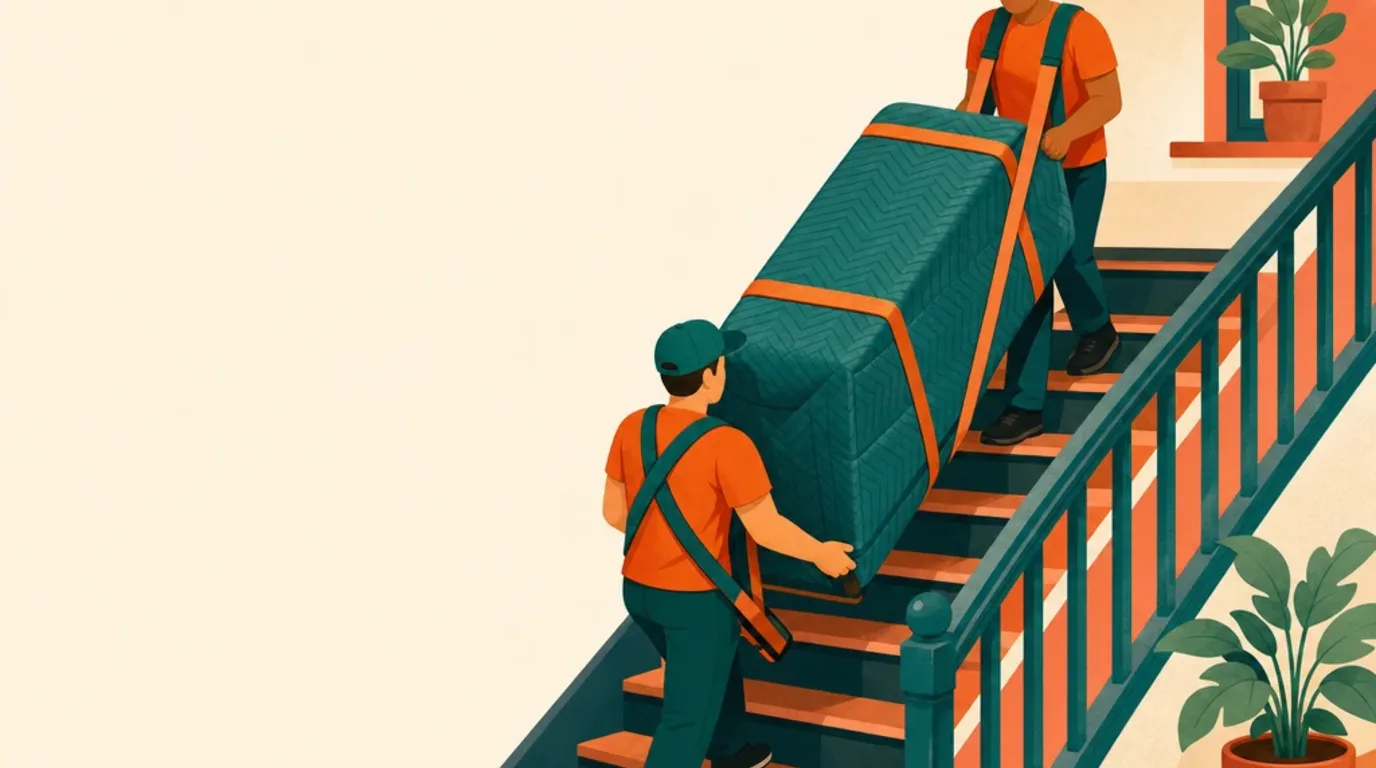
On a no-lift walk-up move, which is the everyday reality in Lakemba, Campsie and much of central Bankstown, the heavy items take the most punishment precisely because they are being carried, turned and angled down tight stairwells rather than wheeled out a door. That is not a reason to worry, it is a reason to use a crew that does these stairs as a normal day, with the right trolleys, straps and blanket-wrapping, and to be clear up front about what cover sits behind the bigger pieces. Tell us about the staircase when you enquire and we plan the carry and the protection around it.
A short checklist before you book
- Ask the removalist, in writing, what their carrier liability is and whether transit insurance is available and at what value.
- Decide which rooms you will pack and which you want packed for you, with the owner-packed limitation in mind.
- Keep the written quote, the inventory and a set of photos of your better pieces before the move.
- If anything is damaged, note and photograph it on the day and put your concern to the removalist in writing first, as the ACCC advises.
None of this is about expecting the worst. It is about knowing where you stand so a small mishap stays small. When you are ready, tell us about your move with a quote request, including the stairs, the lift and the pieces you care about most, and we will be straight with you about how the carry and the cover work for your home.
Common questions
Is a removalist legally responsible if they break my furniture?
Under the Australian Consumer Law a removal service must be carried out with due care and skill. If your goods are damaged because that standard was not met, you are entitled to a remedy, which can include repair, replacement or compensation. The ACCC also notes you cannot claim if the problem came from how you used the service, which is why self-packed boxes are treated differently.
What is the difference between carrier liability and transit insurance?
Carrier liability is the limited baseline responsibility a removalist carries for goods in their care, and it is deliberately low, so on its own it rarely covers the real replacement value of a household. Transit insurance is separate cover, bought for the move, that protects the goods themselves up to a declared value. They are not the same thing, and assuming the first is the second is a common mistake people make.
Does insurance cover boxes I packed myself?
Usually not for breakage. Cover for owner-packed cartons is commonly limited or excluded, because the insurer cannot see how the contents were wrapped. If you want fragile or high-value things fully covered, having the removalist pack them is the cleaner path. Always read what the cover actually says before you rely on it.
Why does AFRA accreditation matter for cover?
AFRA, the Australian Furniture Removers Association, says its members are accredited, screened and regularly audited, carry public liability insurance, can arrange goods-in-transit insurance through a preferred supplier, and offer a dispute-resolution path if something goes wrong. It is an honest signal of a removalist who works to a standard, though it is the cover document, not the badge, that decides what gets paid.
What should I do if something is damaged on move day?
Note it and photograph it at the time, before the crew leaves if you can, and raise it with the removalist in writing rather than only by phone. The ACCC advice is to put the complaint to the business first; a good operator will work it through with you. Keeping the photos, the inventory and the written quote makes any claim far simpler.
Planning a move?
Get a free, no-obligation quote and we'll plan the access at both ends with you.
Get a quote